
RC cars have been a favorite among kids and hobby enthusiasts for decades. Whether it’s racing around the living room, exploring the backyard, or competing on a dedicated track, they offer excitement, skill-building, and plenty of screen-free fun. But with so many options available today, choosing the right RC car isn’t always easy.
Some models are built for speed, while others are designed to conquer rough terrain. Some are perfect for young children, whereas others are intended for experienced hobbyists. Buying the wrong model can result in poor battery life, difficult controls, or simply a disappointing experience.
Taking a little time to understand the important features can help you avoid costly mistakes and choose an RC car that suits the driver’s age, skill level, and intended use. In this guide, we’ll walk through everything you need to know before making a purchase.
Understand Your Purpose Before Buying
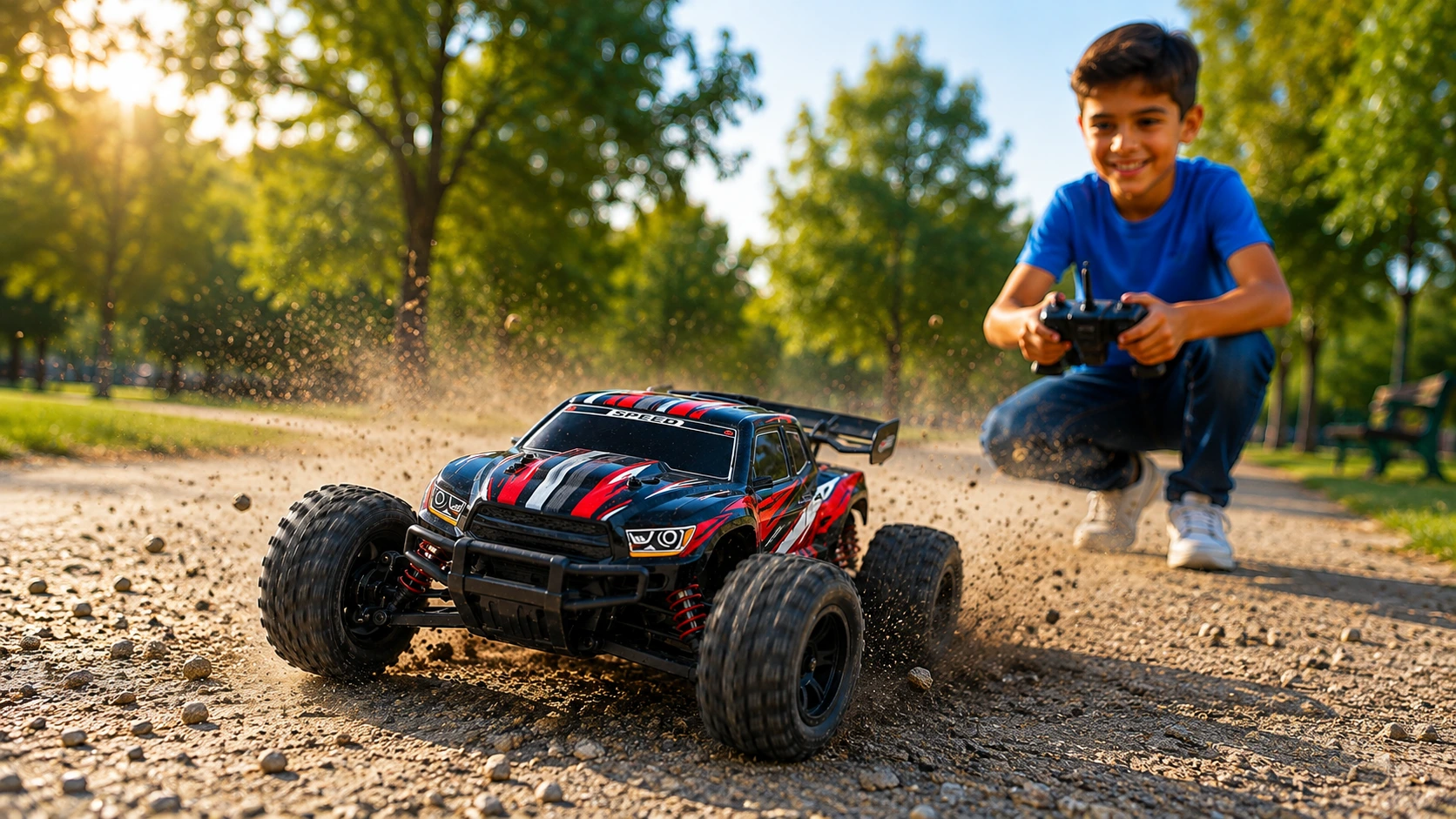
Before comparing motors, batteries, or speed, it’s important to ask one simple question: How will the RC car be used?
Not every RC car is built for the same experience. Some prioritize speed, others focus on durability, and some are designed purely for fun and casual driving. Knowing the purpose makes it easier to narrow down your options and avoid paying for features you may never use.
RC Cars for Racing
If speed is your top priority, racing RC cars are worth considering. These models are built with lightweight bodies, powerful motors, and responsive steering systems that allow them to accelerate quickly and handle corners smoothly.
Racing RC cars are popular among older children, teenagers, and hobby enthusiasts who enjoy competitive driving or simply want the thrill of high-speed performance.
Most racing models perform best on smooth surfaces like pavements, indoor tracks, or dedicated racing circuits. Their low-profile tires and aerodynamic designs help maximize speed and control.
Are racing RC cars suitable for beginners?
Not always. Since racing cars are designed for speed, they can be difficult for first-time users to control. Beginners may find moderate-speed models with adjustable speed settings easier to handle.
How fast do racing RC cars go?
Speed varies depending on the type of RC car.
- Toy-grade racing cars usually reach 10-20 km/h.
- Entry-level hobby-grade models often run between 25-40 km/h.
- Advanced brushless models can exceed 80 km/h and sometimes even reach over 100 km/h.
If pure speed excites you, racing RC cars provide an experience that’s hard to match.
RC Cars for Off-Road Adventures
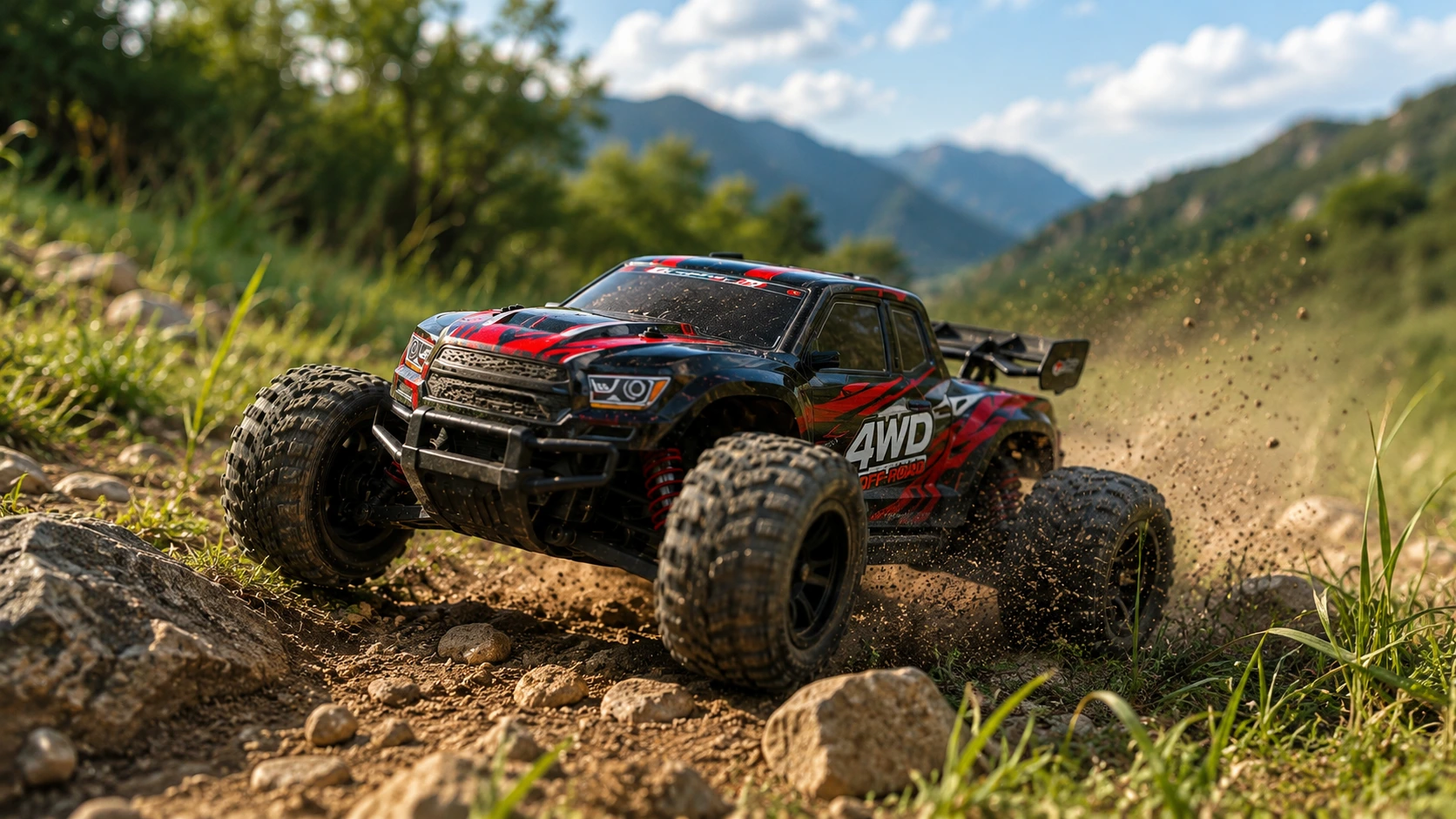
Not everyone wants to stay on smooth surfaces. If your child plans to drive on grass, dirt, gravel, or rocky terrain, an off-road RC car is usually a better choice.
These models are built to handle uneven surfaces without losing traction. Larger tires, stronger suspension systems, and higher ground clearance allow them to tackle bumps and obstacles with ease.
Off-road trucks and buggies are especially popular because they combine durability with versatility. Many are equipped with four-wheel-drive systems that improve stability when driving on loose or slippery surfaces.
Some specialized off-road models are even designed for rock crawling. These vehicles prioritize torque and control rather than speed, allowing them to climb over obstacles and navigate rough terrain.
Which RC cars work best on grass, dirt, and gravel?
Off-road trucks and buggies fitted with large tires and 4WD systems generally perform best. Their suspension and tire design help maintain grip, even on uneven ground.
What makes an RC car suitable for rough terrain?
Several features work together to improve off-road performance:
- High ground clearance prevents the chassis from scraping the ground.
- Rugged tires provide better grip.
- Durable suspension absorbs shocks and impacts.
- Four-wheel drive improves traction and stability.
For outdoor adventures and backyard fun, off-road RC cars offer excellent versatility.
RC Cars for Recreation and Casual Play
Sometimes, speed and extreme performance aren’t necessary. Many families simply want an RC car that’s fun, reliable, and easy to use.
Casual RC cars are designed with simplicity in mind. They often feature moderate speeds, straightforward controls, and durable bodies that can withstand occasional crashes. These models are ideal for younger children and beginners who are just discovering the hobby.
Another advantage is their versatility. Most recreational RC cars work well both indoors and outdoors, making them suitable for everyday play.
If this is your child’s first RC car, choosing a beginner-friendly model can make the learning If this is your child’s first RC car, choosing a beginner-friendly model can make the learning experience much more enjoyable. At KiddiesKart, you can explore a wide range of RC cars from trusted brands like MOKA, Level Honor, Happy Kids, Welly, and D9 Toys. Popular options include MOKA RC Off-Road SUV, the Level Honor FPV WiFi RC Racing Car, Happy Kids stunt RC cars, and D9 Super Off-Road RC Car. With so many choices, it’s easy to find an RC car that matches your child’s age, interests, and driving style.
Check the Motor Type
The motor is essentially the heart of an RC car. It determines how fast the vehicle goes, how much maintenance it requires, and how smooth the driving experience will be.
Understanding the differences between motor types can help you choose a model that matches your expectations.
Electric vs Gas-Powered RC Cars
Electric RC cars dominate the market today, especially among children and beginners. They’re easy to operate, quieter, and require far less maintenance. Most simply need to be charged before use, making them convenient for everyday driving.
Gas-powered RC cars, on the other hand, are mainly aimed at hobby enthusiasts. They deliver impressive power and provide a more realistic driving experience, but they also require regular maintenance and fuel.
Which motor type is easier to manage?
For most buyers, electric RC cars are the better option. They are simpler to use, cleaner, and require less upkeep.
Which offers better performance?
Gas-powered models are powerful, but modern brushless electric systems can deliver incredible speed and acceleration while remaining easier to maintain.
Brushed vs Brushless Motors
Once you’ve decided on an electric RC car, you’ll often encounter another choice: brushed or brushless motors.
Brushed motors are commonly found in beginner-friendly RC cars. They’re affordable, easier to control, and generally provide moderate speeds. This makes them an excellent choice for younger drivers and casual users.
Brushless motors, however, are designed for performance. Since they produce less friction, they are more efficient and capable of delivering higher speeds. Hobby enthusiasts and experienced drivers often prefer brushless systems because they provide better acceleration and longer motor life.
| Feature | Brushed Motor | Brushless Motor |
| Cost | Lower | Higher |
| Speed | Moderate | High |
| Efficiency | Good | Excellent |
| Maintenance | More | Less |
| Best For | Beginners and Kids | Hobby Enthusiasts |
While brushless motors offer superior performance, brushed motors are often the smarter choice for first-time buyers.
Evaluate the Drive System
Another important factor that affects handling and traction is the drive system.
Most RC cars use either two-wheel drive (2WD) or four-wheel drive (4WD). Understanding the difference can help you choose a model that suits your driving environment.
2WD RC Cars
Two-wheel-drive models send power to only two wheels. Because they have fewer moving parts, they are usually lighter, more affordable, and easier to maintain.
They perform best on smooth surfaces and are ideal for casual driving or racing.
4WD RC Cars
Four-wheel-drive models distribute power to all four wheels. This gives them better traction, improved stability, and superior off-road performance.
If you frequently drive on grass, gravel, or dirt, 4WD is often worth the extra investment.
Is 4WD worth the extra cost?
For outdoor adventures and rough terrain, absolutely. The added grip and control make a noticeable difference.
Check the Suspension and Tires
An RC car’s suspension and tires determine how well it handles different surfaces. Two RC cars with the same motor and speed can perform very differently simply because of their suspension setup or tire design.
If you plan to drive indoors, on pavement, or on rough outdoor terrain, choosing the right combination can make a huge difference.
Suspension Types
The suspension system helps absorb shocks and keeps the tires in contact with the ground. Better suspension improves handling, stability, and overall driving performance.
Independent Suspension
Independent suspension allows each wheel to move separately. This gives the car better flexibility and helps maintain traction when driving over bumps or uneven surfaces.
Most racing cars and many off-road models use independent suspension because it delivers smoother handling and better control.
Independent suspension is ideal if you want:
- Better stability at higher speeds
- Improved cornering
- Smoother driving on uneven terrain
For everyday use and recreational driving, independent suspension provides an excellent balance between comfort and performance.
Solid Axle Suspension
Solid axle suspension connects both wheels on the same axle. While it doesn’t offer the same flexibility as independent suspension, it is extremely durable and works well in crawling situations.
Rock crawlers and specialized off-road RC vehicles often use solid axles because they provide excellent articulation when climbing over rocks and obstacles.
If your focus is trail driving or rock crawling rather than speed, solid axle suspension can be a great choice.
Tire Types
Tires are just as important as suspension because they determine how much grip the car has on different surfaces.
Slick Tires
Slick tires have very little tread and are designed for smooth surfaces.
They work best on:
- Indoor floors
- Pavement
- RC race tracks
Because they provide maximum contact with the ground, slick tires deliver excellent speed and handling on flat surfaces. However, they struggle on dirt, grass, and gravel.
Off-Road Tires
Off-road tires feature deeper treads and larger profiles, allowing them to grip loose surfaces more effectively.
They are best suited for:
- Grass
- Dirt
- Gravel
- Mud
These tires provide better traction and stability when driving outdoors.
All-Terrain Tires
If you plan to drive on multiple surfaces, all-terrain tires offer a practical middle ground. They provide decent performance both on roads and rough terrain, making them popular among casual users who want versatility.
Choose an RC Car Based on Age and Skill Level
One of the biggest mistakes buyers make is choosing an RC car that’s too advanced for the driver.
A powerful model may sound exciting, but if it’s difficult to control, the experience quickly becomes frustrating. Matching the RC car to the user’s age and experience level creates a safer and more enjoyable learning curve.
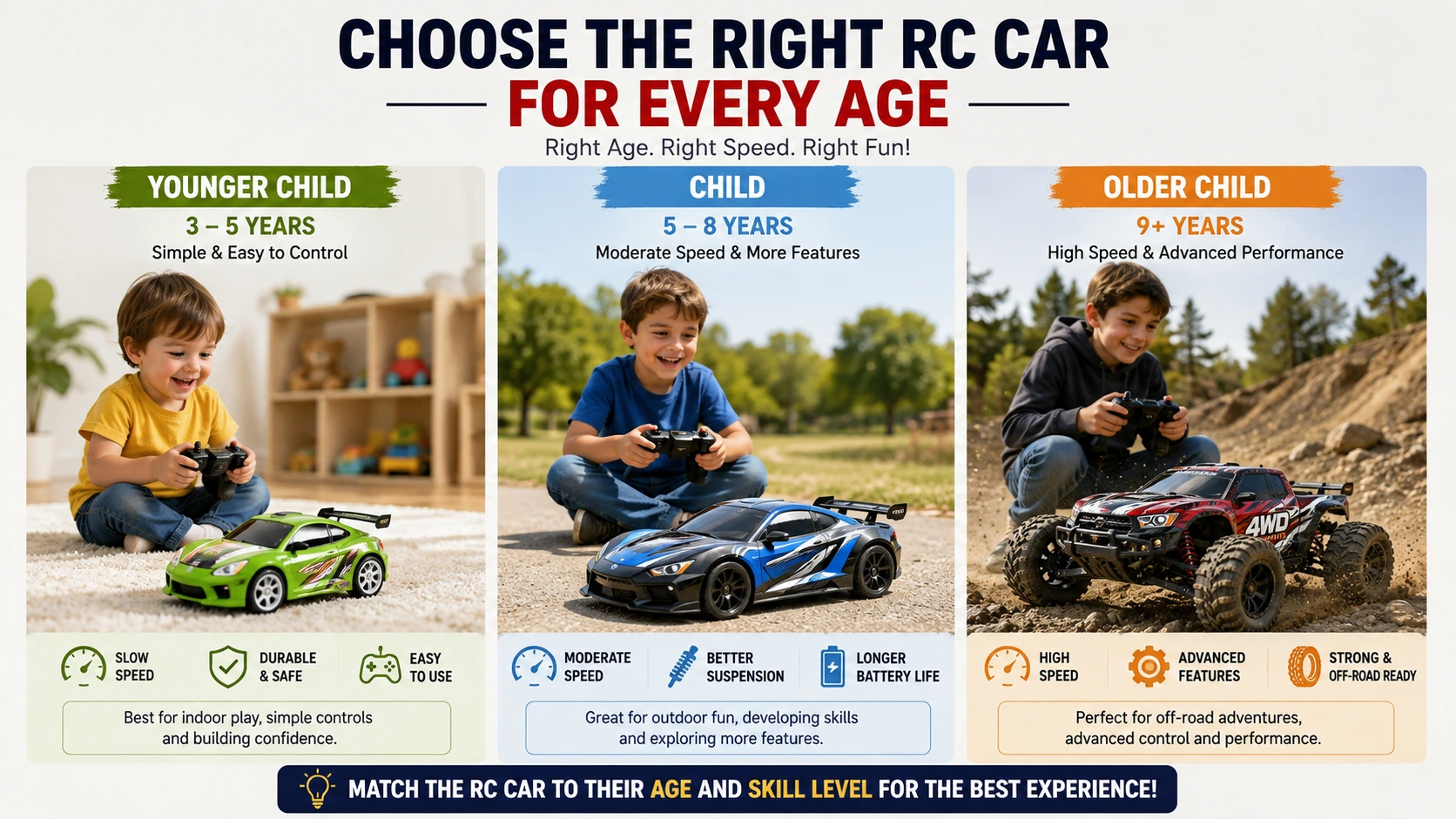
Ages 3-5
Young children need simplicity more than speed.
At this age, durability and ease of use are far more important than performance. Look for RC cars with large buttons, simple controls, and slow speeds. A sturdy body can also help the vehicle survive accidental bumps and crashes.
These models are designed to introduce children to the basics of remote control without overwhelming them.
Ages 5-8
Children in this age group can handle slightly faster vehicles and more responsive controls.
Rechargeable batteries become especially useful because kids tend to spend more time driving and less time waiting for battery replacements.
Moderate speeds and better steering controls provide a balance between excitement and safety.
Ages 8-12+
Older children often enjoy RC cars with greater speed and more advanced features.
At this stage, many kids begin to understand concepts like steering precision, speed control, and terrain handling. Adjustable speed settings are particularly useful because they allow drivers to gradually build confidence.
Off-road trucks and entry-level hobby-grade RC cars are often excellent choices for this age group.
Off-road trucks and entry-level hobby-grade RC cars are often excellent choices for this age group. Families looking for outdoor adventure can consider the MOKA RC Off-Road SUV or MOKA Rock Crawler, while kids who enjoy realistic driving may love the Level Honor FPV WiFi RC Racing Car. KiddiesKart also offers Happy Kids RC stunt cars, Welly remote control vehicles, and D9 Toys RC Motor Boat, giving children plenty of exciting options for every play style.
Teens and Hobby Enthusiasts
Teenagers and experienced drivers typically look for performance and customization.
Hobby-grade RC cars offer upgradeable parts, more powerful motors, and better suspension systems. Many enthusiasts enjoy modifying their vehicles with upgraded tires, batteries, or brushless motors to improve speed and handling.
For people who view RC cars as a long-term hobby rather than a toy, upgrade potential becomes just as important as the initial specifications.
Prioritize Safety Features
Safety is often overlooked, but it’s especially important when buying RC cars for younger children.
A well-designed RC car should provide fun without unnecessary risks.
Materials and Construction
The materials used in an RC car affect both safety and durability.
Look for models made from:
- Non-toxic materials
- Child-safe plastics
- Durable ABS plastic construction
These materials are lightweight, strong, and better able to withstand accidental impacts.
Safe Design Features
Small design details can make a big difference.
Features such as rounded edges and flexible body components help reduce the chances of injury. Bendable antennas are another useful addition because they are less likely to snap during play.
Secure battery compartments also prevent children from accessing internal components.
What makes an RC car safe for young children?
A safe RC car combines:
- Moderate speeds
- Durable construction
- Non-toxic materials
- Simple controls
- Child-friendly design
Choosing an age-appropriate model is one of the best ways to ensure safe play.
Consider Your Budget Carefully
RC cars are available in almost every price range, from affordable beginner models to premium hobby-grade machines.
While it’s tempting to focus only on the purchase price, long-term value matters just as much.
Entry-Level RC Cars
If you’re buying an RC car for the first time, an entry-level model is often the smartest choice.
These cars are affordable, easy to use, and provide enough performance for casual fun. They allow beginners to enjoy the hobby without making a large investment.
For many families, simple and reliable is often better than expensive and overly complicated.
Long-Term Value
Spending slightly more upfront can sometimes save money over time.
Higher-quality RC cars generally offer:
- Better durability
- Longer battery life
- Upgrade potential
- Improved performance
If you expect the RC car to be used frequently, investing in quality often pays off.
Hidden Costs
Many buyers only consider the initial price and forget about ongoing expenses.
Over time, you may need:
- Replacement batteries
- Spare tires
- Chargers
- Suspension parts
- Maintenance accessories
Hobby-grade models can also require occasional upgrades and repairs.
Understanding these additional costs helps you set a realistic budget and avoid surprises later.
Read Reviews and Check Brand Reputation
Before making a final decision, it’s worth spending a few minutes reading customer reviews.
Specifications tell only part of the story. Real-world experiences often reveal how durable an RC car really is, how long the battery lasts, and whether the controls are easy to use.
Reviews can also highlight common issues that aren’t obvious from product descriptions.
Trusted brands generally provide:
- Better customer support
- Warranty protection
- Spare parts availability
- More reliable quality
Choosing a reputable brand can make ownership easier, especially if repairs or replacement parts are needed in the future.
Battery Life and Charging Time
No matter how powerful an RC car is, the fun comes to a halt when the battery runs out. Battery performance directly affects playtime, charging convenience, and overall ownership costs.
Understanding the different battery options can help you choose a model that matches your expectations.
Battery Types
Most RC cars use either rechargeable battery packs or replaceable AA/AAA batteries.
Rechargeable Batteries
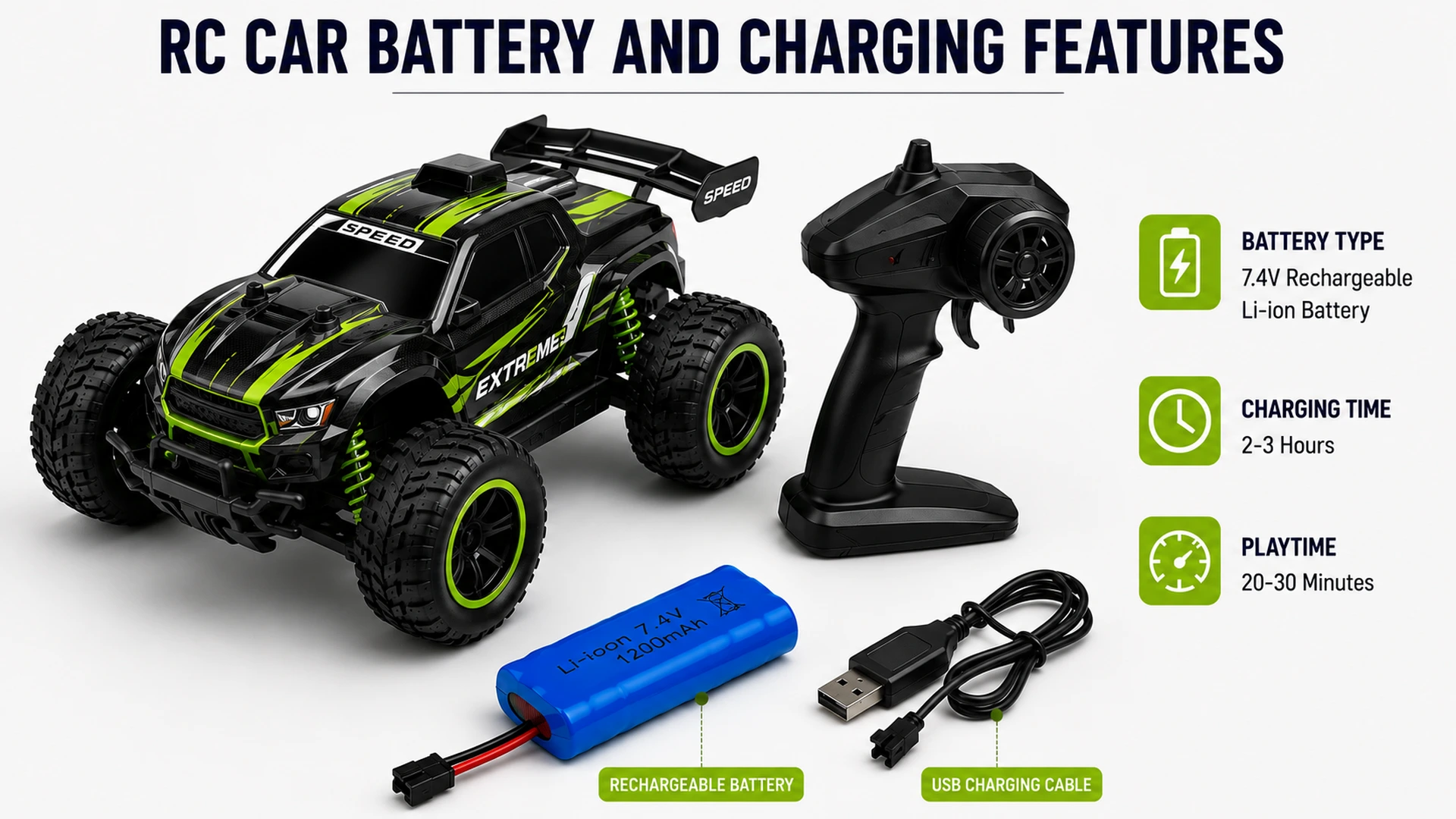
Rechargeable batteries have become increasingly popular because they are cost-effective and environmentally friendly. Instead of constantly buying disposable batteries, you simply recharge the battery pack and continue driving.
Many modern RC cars now support USB-C charging, making them even more convenient.
Rechargeable batteries are ideal for:
- Frequent use
- Longer-term savings
- Reduced waste
- Better overall performance
Although the initial cost may be slightly higher, they are usually the better option for regular users.
AA/AAA Batteries
Some entry-level RC cars still rely on standard batteries. These are easy to replace and can be convenient during travel or outdoor trips where charging isn’t readily available.
However, replacing batteries repeatedly can become expensive over time.
For occasional use, AA batteries work well, but rechargeable systems provide better value in the long run.
Run Time Expectations
Battery runtime varies depending on the size of the battery, motor type, and driving conditions.
Most RC cars provide anywhere between 10 and 40 minutes of continuous use.
| RC Car Category | Average Runtime |
| Beginner RC Cars | 10-20 Minutes |
| Mid-Range RC Cars | 20-30 Minutes |
| Hobby Grade RC Cars | 30-40+ Minutes |
Keep in mind that aggressive driving, rough terrain, and higher speeds consume more battery power.
How long should an RC car battery last?
A quality RC car should ideally provide around 20-30 minutes of runtime on a full charge. Many hobbyists purchase an extra battery pack to extend play sessions without waiting for a recharge.
Charging Time
Charging times vary depending on battery capacity and charger quality.
Most RC cars require between one and three hours to fully recharge.
Smaller batteries usually charge within an hour, while larger battery packs may take two to three hours.
Fast charging is convenient, but it’s equally important to follow the manufacturer’s recommendations to maintain battery health and maximize lifespan.
Inspect Build Quality and Durability
Even the fastest RC car won’t last long if it’s poorly built. Crashes, bumps, jumps, and rough terrain are all part of the experience, which makes durability one of the most important factors to consider.
A well-built RC car not only survives accidents better but also provides greater long-term value.
Construction Materials
Manufacturers use different materials depending on the intended use and price range.
ABS Plastic
ABS plastic is widely used in beginner and toy-grade RC cars because it offers a good balance between durability and affordability.
It is lightweight, impact-resistant, and suitable for everyday play.
Reinforced Polycarbonate
Higher-end models often feature reinforced polycarbonate bodies. This material provides better protection against crashes and high-speed impacts.
If durability is a priority, polycarbonate bodies are worth considering.
Metal Components
Many hobby-grade RC cars include metal gears, driveshafts, and suspension parts.
Metal components increase strength and longevity, especially during aggressive driving. Although they add to the overall cost, they often improve reliability and performance.
Repairability
No RC car is completely crash-proof. Sooner or later, certain components may wear out or break.
This is where repairability becomes important.
Before buying, check whether spare parts are easily available. Components such as tires, batteries, shock absorbers, and body shells should be replaceable without much difficulty.
Hobby-grade RC cars generally offer better upgrade compatibility and replacement options than toy-grade models.
Choosing a model with good parts availability can save both money and frustration in the future.
Maintenance Requirements
Like any machine, RC cars perform better when properly maintained.
Regular care doesn’t have to be complicated. A few simple habits can greatly extend the life of your vehicle.
After outdoor use, it’s a good idea to remove dirt and debris from the tires and chassis. Batteries should always be stored and charged according to the manufacturer’s recommendations.
Periodic tire inspections and checking loose screws can also help prevent larger issues from developing.
A little maintenance goes a long way in keeping an RC car running smoothly.
Look for Modern Control Features
Technology has transformed RC cars over the years. Today’s models offer features that improve control, increase safety, and make driving easier for beginners.
These features may not always be essential, but they can significantly enhance the overall experience.
2.4 GHz Technology
Modern RC cars typically use 2.4 GHz radio systems, which offer more reliable communication between the transmitter and the vehicle.
Compared to older frequencies, 2.4 GHz technology provides:
- Better signal stability
- Longer operating range
- Reduced interference
- The ability to run multiple RC cars simultaneously
This feature is especially useful when several children or hobbyists are driving together.
Adjustable Speed Controls
Not everyone needs maximum speed right away.
Adjustable speed controls allow beginners to start slowly and gradually increase performance as their confidence improves.
This feature is particularly valuable for younger children because it reduces the risk of accidents and makes the learning process much smoother.
Parents often appreciate speed-limiting functions because they provide better control over how fast the vehicle can go.
Advanced Smart Features
Premium RC cars are becoming increasingly sophisticated.
Some models now offer innovative features such as:
Gesture Control
These RC cars respond to hand movements instead of traditional joysticks, creating a more interactive experience.
Follow Mode
Certain smart RC cars can automatically follow the user, making them more engaging and easier to control.
Obstacle Sensing
Advanced sensors help prevent collisions by detecting objects in the vehicle’s path.
While these features aren’t necessary for everyone, they can add an extra level of excitement and convenience.
Choosing Based Only on Speed
One of the biggest misconceptions about RC cars is that faster always means better.
While high-speed RC cars are exciting, they aren’t necessarily the best choice for everyone. Younger children and beginners often struggle to control extremely fast vehicles, which can lead to frequent crashes and frustration.
For many first-time users, a moderate-speed RC car offers a much more enjoyable experience. As driving skills improve, upgrading to a faster model becomes easier and safer.
Fast Isn’t Always Better
When buying an RC car, it’s important to balance speed with factors like control, durability, and ease of use.
A slower RC car that handles well will usually provide more enjoyment than a high-speed model that’s difficult to manage.
Ignoring Terrain Requirements
Another common mistake is forgetting where the RC car will actually be driven.
A racing RC car that performs brilliantly on smooth surfaces may struggle completely on grass or gravel. Similarly, an off-road truck designed for rough terrain may feel less responsive indoors.
Before buying, think about the surfaces where the vehicle will spend most of its time.
Beach Sand
Beach sand presents unique challenges because it creates extra resistance and can damage internal components if not cleaned properly. Larger tires and sealed drivetrains are better suited for sandy environments.
Grass
Thick grass requires more power and better traction. Four-wheel-drive systems and off-road tires perform much better than standard racing tires.
Dirt Tracks
Dirt surfaces demand strong suspension and tires with deeper tread patterns. Off-road trucks and buggies are often the best choice.
Matching the RC car to the terrain helps improve performance and extends the life of the vehicle.
Overlooking Indoor Usage
Many buyers focus only on outdoor performance and forget that RC cars are often driven indoors as well.
High-speed models can easily damage furniture, walls, and household items when used inside. They also require more open space to operate safely.
If indoor driving is important, consider choosing a model with:
- Adjustable speed settings.
- Good steering control.
- Smaller dimensions.
- Softer tires for better grip.
A beginner-friendly RC car is usually much easier to manage inside the house.
Overspending on Features You Won’t Use
Modern RC cars come with countless features, from brushless motors and aluminum components to gesture controls and advanced app connectivity.
While these upgrades sound impressive, not every driver actually needs them.
For example, a six-year-old child probably won’t benefit from a high-speed brushless system or expensive metal upgrades. Similarly, casual users may never use racing features designed for hobby enthusiasts.
Before spending extra money, ask yourself:
- Do I really need extreme speed?
- Will I use advanced customization options?
- Does the driver have enough experience to appreciate premium features?
- Would that money be better spent on spare batteries or replacement parts?
Buying based on actual needs rather than specifications often leads to greater satisfaction.
Final Buying Advice
Choosing the right RC car becomes much easier when you think about the complete experience rather than just individual specifications.
Start by identifying who will use the RC car and where it will be driven. A young child has very different needs compared to a hobby enthusiast or competitive racer.
Next, consider the motor type, drive system, suspension, and tire setup. These factors determine how the vehicle performs and what surfaces it can handle.
Battery life and charging time are equally important because they affect how long the fun lasts. Build quality, repairability, and spare parts availability should also be considered, especially if the RC car will be used regularly.
Finally, don’t overlook safety features, customer reviews, and brand reputation. These details often make a bigger difference over time than raw speed or flashy features.
Quick RC Car Buying Checklist
- Before making your purchase, ask yourself:
- What is the main purpose – racing, off-road driving, or casual play?
- Is the RC car suitable for the driver’s age and skill level?
- Do I need 2WD or 4WD?
- Is a brushed motor enough, or do I need a brushless system?
- Will the tires and suspension suit the terrain?
- How long does the battery last, and how quickly does it recharge?
- Are replacement parts available?
- Is the build quality durable enough for regular use?
- Does the car include useful features like 2.4 GHz control or adjustable speed settings?
- Am I paying for features I’ll actually use?
Answering these questions can help narrow down your options and prevent expensive mistakes.
Conclusion
RC cars come in a wide variety of styles, speeds, and price ranges, which is why choosing the right one requires more than simply looking at the fastest model or the most attractive design.
The best RC car depends on several factors, including the driver’s age, experience level, preferred terrain, and budget. Understanding motor types, drive systems, suspension, battery performance, durability, and modern control features helps ensure that you choose a model that delivers the right balance of fun, performance, and reliability.
Whether you’re buying an RC car for a young child, a beginner, or a serious hobby enthusiast, taking the time to research your options can make all the difference.
With the right choice, an RC car can provide years of excitement, skill development, and countless hours of outdoor and indoor fun. If you’re ready to find the perfect model, browse our RC Car Collection and choose an option that matches your child’s interests and experience level
At KiddiesKart, you’ll find an exciting collection of RC cars from leading brands including Rastar, Welly, MOKA, Level Honor, Happy Kids, and D9 Toys. From realistic licensed RC cars and FPV racing models to off-road SUVs, monster trucks, and rock crawlers, there’s an RC vehicle for every age, skill level, and adventure. Explore our RC Car Collection to find the perfect model and bring home hours of action-packed, screen-free fun.